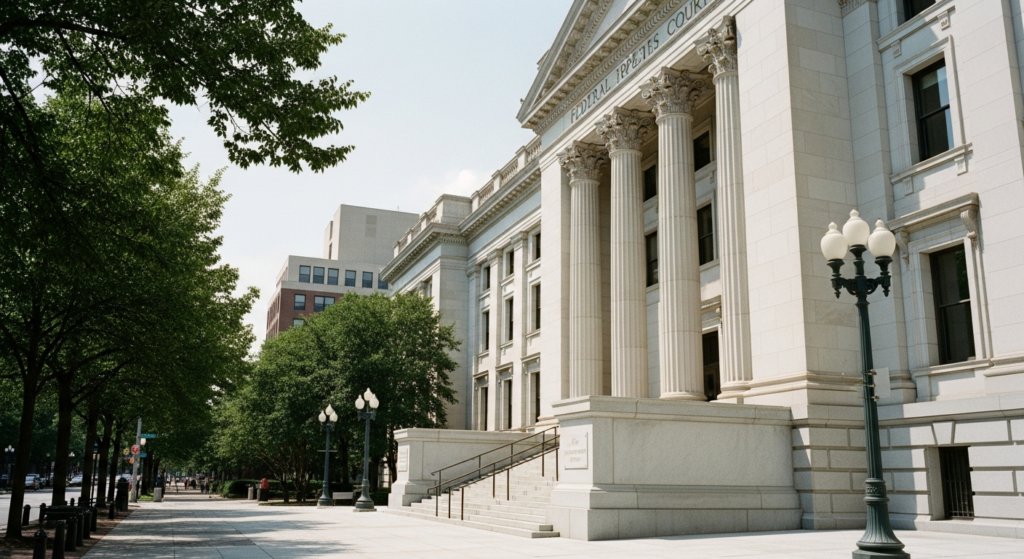
A federal appeals court has ordered a halt to above-ground construction of a proposed $400 million White House ballroom, ruling that the Trump administration must secure congressional approval for the project. The decision, handed down by a divided three-judge panel of the U.S. Court of Appeals for the District of Columbia Circuit, marks a significant legal setback for the administration’s plans.
The 2-1 ruling, issued on August 9, 2026, upheld an earlier April 16 order by U.S. District Judge Richard Leon, which had similarly paused above-ground work. While the appeals court’s decision stops visible construction, it explicitly permits underground work on a bunker and other national security facilities to continue, acknowledging the administration’s security concerns.
The majority opinion was supported by Judges Patricia Millett and Bradley Garcia. Judge Millett was nominated to the court by President Barack Obama, and Judge Garcia by President Joe Biden. Dissenting from the majority was Judge Neomi Rao, who was nominated by President Donald Trump. The court’s split reflects differing judicial interpretations of executive authority and congressional oversight regarding federal spending and construction projects.
The planned ballroom, envisioned as a sprawling 90,000-square-foot (8,400-square-meter) facility, is slated to occupy the site of the former White House East Wing. The East Wing, a historic section of the executive mansion, was demolished in the fall of 2025 to make way for the new construction. The scale of the proposed project, with its estimated $400 million price tag, has drawn considerable scrutiny since its inception.
The legal challenge against the project was initiated by the National Trust for Historic Preservation. The organization filed a lawsuit in December 2025, just one week after the demolition of the East Wing was completed. Their central argument asserted that the ambitious construction project could not proceed without explicit authorization from Congress, citing established legal precedents for federal appropriations and oversight.
Congressional opposition to the ballroom has been evident for months. In May, Congress rejected the administration’s request for $1 billion in funding specifically for the ballroom project. Further complicating the financial picture, Democrats alleged in June that approximately $350 million from a recent tax cuts law appeared to have been redirected to White House security initiatives, including components related to the ballroom’s development. These claims have fueled a broader debate over fiscal transparency and the allocation of federal funds.
Following its ruling, the appeals court issued a 14-day stay, allowing the Trump administration a window to appeal the decision to the U.S. Supreme Court. This period provides a critical opportunity for the administration to seek a higher court’s intervention, potentially escalating the dispute to the nation’s highest judicial body. The outcome of any such appeal would have significant implications for the project’s future and the balance of power between the executive and legislative branches.
The ongoing legal and political battle over the White House ballroom underscores fundamental questions about the separation of powers and the constitutional requirement for congressional appropriation of funds. Federal projects, particularly those involving significant public expenditure and historic sites, typically undergo rigorous review and approval processes by the legislative branch. This case highlights the tension that can arise when executive ambitions clash with legislative oversight.
Why it matters in Greer
The federal appeals court’s decision to halt construction on the White House ballroom, pending congressional approval, resonates beyond Washington D.C. for communities like Greer. While the project is geographically distant, the underlying principles of federal spending oversight and the separation of powers have direct implications for how taxpayer dollars are managed and how large-scale federal initiatives are funded. For residents and businesses in Greer, including major employers like BMW Manufacturing Co. and GSP International Airport, national fiscal responsibility and the integrity of federal budgeting processes are crucial. Decisions on federal spending can indirectly influence the broader economic climate, federal infrastructure investments, and even the availability of resources that might eventually benefit Upstate South Carolina. The precedent set by this ruling reinforces the importance of legislative checks and balances on executive spending, a principle that underpins stable governance and predictable economic conditions for communities across the nation, including Greer.